📌 The implementation of a robust ETL pipeline (Extraction, Transformation, Loading) has transitioned from a mere option to an absolute necessity.
A Paradigm Shift in Materials Science: Data as the Core Competitiveness
In the modern era of Data-Driven Materials Science, moving away from the traditional trial-and-error approach, researchers worldwide are attempting to radically shorten the discovery period for new materials through AI. However, the most significant barrier encountered in many research environments is, paradoxically, the lack of ‘usable and valuable data.’ While vast amounts of data are generated daily from numerous experimental instruments, only a tiny fraction is refined enough to be fed into AI models.
To solve this problem, the first essential step is the implementation of an ETL pipeline. ETL is not merely a process of moving data; it is a series of intellectual procedures that uncover hidden causal relationships within fragmented experimental results and reconstruct them into a ‘machine-learnable’ format. In this process, the core element that determines the value of data lies not in the result values themselves, but in how the data is interpreted based on the ‘Process Conditions’ that produced those results.
The Importance of Process Conditions
The most critical component of experimental data is not the simple measurement of a physical property, but all the environmental variables controlled to derive that result. For instance, consider electrochemical characterization data for a secondary battery electrode. The final performance value of a specific electrode is inextricably linked to detailed process conditions, such as the stirring speed during slurry mixing, the drying temperature during coating, and the pressure applied during the calendering process.
These process conditions serve as the core variables for AI to learn ‘why such a result occurred’ and to predict the properties of new materials. Therefore, researchers with domain expertise in materials science strive to define which process variables significantly impact the final properties and integrate them organically into the experimental data structure. Understanding the systematic management of process conditions and converting them into data is the true starting point of data-driven materials research.
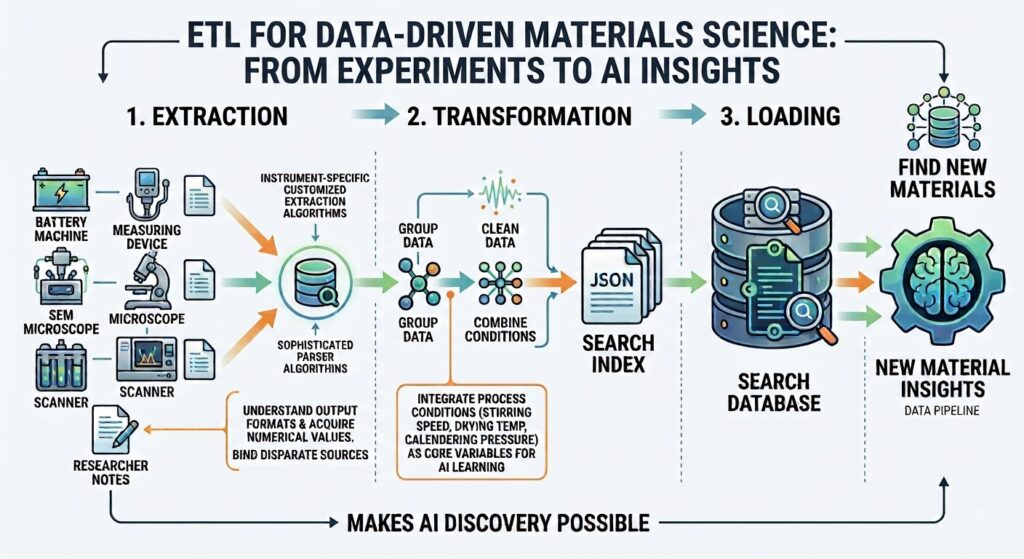
Step 1: Extraction – Integrating Heterogeneous Instruments and Process Records
Extraction, the first stage of the ETL pipeline, is the process of collecting data from various heterogeneous instruments within the laboratory. Materials research sites utilize numerous devices from different manufacturers—such as battery cyclers, viscometers, SEMs, and XRDs—each outputting data in its own format, whether it be CSV, XML, or a proprietary binary format.
The key point here is the design of ‘instrument-specific customized extraction algorithms.’ It is not enough to simply collect files; one must accurately understand the output format of each device to acquire only the numerical values necessary for research. Particularly when process conditions are not included in the instrument’s output file but are recorded in a researcher’s notes or a separate control system, sophisticated Parser algorithms are required to bind these disparate sources together. This stage must be robust to secure high-quality experimental data that is genuinely useful for machine learning.
Step 2: Transformation – Data Standardization and Becoming ‘AI-Ready’
Once extracted, the data undergoes a transformation stage to finally take the form of knowledge. This involves unifying the units of data collected from different instruments, removing noise, and accurately matching the aforementioned process conditions to individual experimental sequences.
During this process, it is highly advantageous to convert the data into JSON (JavaScript Object Notation) format. Since materials research data is inherently unstructured—with process variables varying significantly depending on the type of experiment—a flexible JSON structure based on Key-Value pairs is far more suitable than rigid relational databases (RDBMS). A state where process conditions and property data are hierarchically well-structured is referred to as a basic ‘AI-Ready’ dataset. (Note that more specialized AI-Ready datasets may require additional processing and transformation.) This represents the optimal state where AI models can be deployed for training immediately without further preprocessing.
{
  "process_data": {
    "mixing": { "speed_rpm": 1200, "time_min": 60 },
    "coating": { "drying_temp_c": 160, "thickness_um": 50 },
    "rolling": { "pressure_mpa": 80, "speed_m_min": 15 }
  },
  "property_results": {
    "energy_density_wh_kg": 250,
    "power_density_w_kg": 8000,
    "cycle_life": 1500
  }
}
[Code] JSON example of process and properties data in materials science
Step 3: Loading – Building the Foundation for Flexible Exploration
The final loading stage involves storing the processed JSON data into a database. The priority here is not just storage, but ‘search efficiency.’ Indexing optimization must be performed simultaneously so that a researcher can instantly call up, for example, “all electrode cycle life data coated within a specific temperature range.” When such systematic loading is achieved, diverse materials data of different formats can finally be fused within a single platform to provide new insights.
Conclusion and Next Post: The Advantages of Indexing-Based Flexible Schema Design
Ultimately, successful data-driven materials research is realized when researchers deeply recognize the importance of process conditions and metadata (data that describes data) and manage them within the framework of an ETL pipeline. A well-designed pipeline not only reduces a researcher’s repetitive manual tasks but also paves a high-speed highway for AI to grasp the complex causal relationships in materials science.
In the next post, we will take a closer look at the detailed implementation of these ETL pipelines. We will explore how to construct a flexible schema based on indexing using tools like elasticsearch and discuss in-depth how to efficiently process vast amounts of materials big data.